
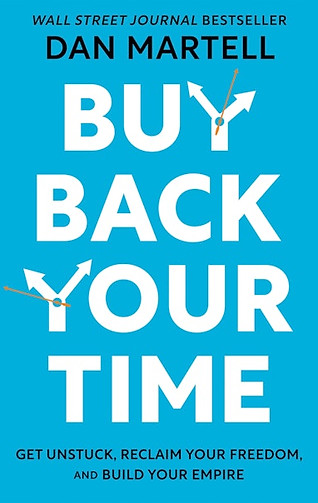
BUY BACK YOUR TIME: GET UNSTUCK, RECLAIM YOUR FREEDOM AND BUILD YOUR EMPIRE
A calendar is where our stated priorities meet our actual energy and
behaviour.
The main lesson I took from The Buy Back Your Time: Get
Unstuck, Reclaim Your Freedom and Build Your Empire is a
practical one. Your calendar should allocate your best energy
time to your priorities.
Dan Martell gives readers methods for examining where their
time goes, what that time costs and which activities should be
removed, delegated or redesigned.
I used parts of the method while planning my 2026. The exercise helped me recover time and make more deliberate choices about the year ahead. It worked well and I have now integrated this into my annual planning process.
Why I Chose This Book
It is easy to know in general terms that a week has not gone as planned. It is harder to identify exactly where the time went and why certain days left little energy for the work that mattered.
The book gave me a structure for looking at both.
When I applied some of the exercises to my 2026 planning, I began by reviewing the commitments already competing for space. That changed the planning conversation.
This made the plan more credible. There was a clearer connection between what I wanted to accomplish and the time available to do it.
Book Overview
Buy Back Your Time is written for people whose calendar is full and unhappy about their output. Its ideas also apply to executives, investors, board members and professionals whose responsibilities have expanded faster than their working methods.
Dan Martell asks readers to stop treating long hours as the default response to a crowded workload. Use delegation, documentation and better calendar design to create room for work on what carries greater value.
The book includes practical exercises for reviewing how you spend your time. You identify activities that drain or create energy, consider the economic value of your working hours and decide which recurring responsibilities someone else could perform.
Some calculations are uncomfortable.
The book also addresses what happens after a task has been delegated. Unless the expected result and process are clear, the task may return in the form of questions, correction and supervision. Documentation therefore becomes part of buying back time.
This is where the book becomes relevant beyond personal productivity. A documented process makes delegation easier and reduces dependence on one person’s memory. This is a single point of failure we do not want as well.
Key Ideas
Begin with Evidence From Your Calendar
A time audit works best when it is based on what actually happened.
Look at the previous two weeks. Mark the activities that required your particular judgement. Identify those that another person could perform with the right instructions. Or a well thought out decision tree would remove.
Include energy in the review. Two meetings may each last an hour while having very different effects on the rest of the day. Identify which meetings increase or drain your energy.
Put a Value on Your Working Time
The book asks readers to calculate the approximate value of an hour of their time and use that figure when reviewing routine work.
The calculation is imperfect, but it is useful. It makes the opportunity cost of a task more visible.
Suppose a senior executive spends two hours each week preparing a recurring report that could be produced by someone else. The apparent saving is the cost of that support. The hidden cost is the work the executive did not do during those two hours.
The value-of-time calculation gives leaders a reason to review those habits before they become embedded in the working week.
Make Delegation Repeatable
Passing a task to someone without defining the expected result rarely saves much time.
The book’s emphasis on playbooks and clear completion standards is useful here. A repeatable task should have a documented outcome, the information needed to perform it and a clear point at which it can be considered complete.
Writing down the process reveals undocumented assumptions. It also improves continuity when responsibilities change.
A useful playbook does not need to become a large manual. It needs to give another capable person enough information to produce the required result without returning at every step.
Give Recovered Time a Purpose
A free hour will not remain free for long unless it has a designated use.
Recovered time should therefore be placed deliberately in the calendar. It might be reserved for strategic thinking, a strategic issue, preparation for a difficult discussion or time with family. Some of it should be left available for recovery.
I have written elsewhere that recovery is part of resilience.
Buying back time should allow you to direct more attention towards the life and work you have chosen. Filling every recovered hour with another obligation would defeat that purpose.
Why It Matters
Time is difficult to manage because poor allocation rarely produces an immediate warning.
A financial overspend appears in an account. A poorly used afternoon simply passes.
For directors and executives, the consequences extend into the organisation. Leadership attention affects which risks receive proper discussion, whether people receive adequate support and how much thought is given to longer-term decisions.
A leader can remain busy while important work is repeatedly postponed. Strategic thinking is especially vulnerable because it seldom presents itself as the most urgent item in the diary.
The same problem can affect a board. Routine reporting expands to occupy the available agenda. Discussion of succession, culture or emerging risks is then shortened or moved to a later meeting.
This is also why the exercise belongs in annual planning. A plan that ignores the capacity required to execute it is a statement of intention.
Who Should Read This Book
-
This book will be particularly useful if:
-
Your business has grown, but you remain involved in recurring operational work that others could perform.
-
Your calendar is full, yet important strategic matters continue to move from one week to the next.
-
You chair meetings in which routine reporting takes up most of the available discussion time.
-
You are preparing an annual plan and want to test whether your schedule can support what you intend to accomplish.
Actionable Takeaways
1. Review the Previous Two Weeks
Open your calendar and examine what actually happened
For each substantial activity, note whether it required your judgement, whether it created or reduced energy and whether it could be removed or reassigned.
Do not try to correct anything during the first review. The aim is to see the pattern before changing it.
2. Choose One Recurring Task
Select a task that occurs every week or month and does not require your direct involvement.
Record how you currently perform it. Define the result that is needed and the standard that must be met.
Transfer that task before attempting a larger redesign of your working life.
3. Design the Week Before It Fills Up
Reserve time for the work connected to your main priorities before accepting routine commitments.
Leave space between activities where possible. A diary without any margin assumes that every meeting will finish on time and no unexpected issue will arise.
4. Include Time in the Annual Planning Process
Start with the Question: Is the way I am spending my time consistent with the work and life I am trying to build?
Check when setting objectives for the coming year, estimate how much attention each one will require.
Then compare that requirement with the calendar. If the time does not exist, the plan needs to change or another commitment must move.
5. Repeat the Audit
A single audit can improve a calendar, but responsibilities will continue to change.
Repeat the exercise quarterly. Look for tasks that made sense when they began but no longer require your involvement.
6. After completing the first audit, place a recurring question in your calendar:
Is the way I am spending my time consistent with the work and life I am trying to build?
Then Review calendar, identify one recurring activity that you will remove, delegate or redesign. This creates continuous positive change.
My Perspective
We tend to fall back on the quality of our systems when work becomes demanding.
That is why I found Buy Back Your Time useful. The book gave me a process for examining the compromises already embedded in my calendar.
My experience of using the method during my 2026 planning was instructive. My first instinct was to consider what I wanted to add during the year. The time audit forced me to look at the existing commitments first.
That changed several decisions. Some activities needed clearer limits. Others could be handled through a more consistent process. A few deserved less space than they had been receiving.
This is a familiar issue in governance. Boards expect management to allocate financial capital according to strategy. Attention deserves similar care. Every hour assigned to one subject is unavailable for another.
The question is especially important for a chair. Agenda design influences the quality of a board’s contribution. If papers repeat information or routine reports dominate the meeting, directors have less opportunity to examine assumptions and discuss difficult decisions.
I recommend reading this book alongside 10x Is Easier Than 2x: How World-Class Entrepreneurs Achieve More by Doing Less by Dan Sullivan and Benjamin Hardy.
10x Is Easier Than 2x encourages greater selectivity about the activities that deserve attention. Buy Back Your Time helps create the capacity required to act on that selectivity.
Or read this alongside The One Thing: The Surprisingly Simple Truth behind Extraordinary Results
How to focus on the “One Thing I can do such that by doing it everything else will be easier or unnecessary”
Or read this alongside The 12 Week Year: Get More Done in 12 weeks Than Others Do in 12 Months.
A way to focus, plan and execute One Thing to completion in a short space of time rather than divide energy and focus across many project.
Indeed, the combination of books go very well together.
For me, the practical outcome is a move towards a life by design rather than a life by default.
Continue the Journey
Buy the Book Buy Back Your Time on Amazon
Buy the Book 10x Is Easier Than 2x on Amazon
Buy the Book The One Thing On Amazon
Buy the Book The 12 Week Year On Amazon
Disclosure: These are affiliate links. If you buy through them, I may earn a commission at no extra cost to you.
About Arnold Spruit
Board Chair, Non-Executive Director, investor, writer and father of four based in Luxembourg.
I write about resilience, leadership, governance, wealth creation and human potential.
Related Reading Guides

The Leader's Camino
A practical guide for leaders navigating transition, reinvention and growth. Using the Camino pilgrimage as a metaphor, the book explores how successful leaders move from achievement towards purpose, contribution and renewed growth.
Topics: Leadership, Personal Growth, Executive Transition, Purpose
Read Guide →

10x Is Easier than 2x
Coming Soon
Read Guide →

Buy Back Your Time
Coming Soon
Read Guide →